Evaluating 3D Christmas Clouds Backgrounds for Holiday Design Projects
Selecting the right visual assets for holiday campaigns requires a balance between aesthetic appeal and technical functionality. As designers and content creators prepare for the festive season, the demand for immersive imagery has shifted from static, flat illustrations to more dynamic, dimensional compositions. Among the emerging trends in this space are 3D Christmas Clouds Backgrounds. These assets offer a distinct alternative to traditional snow-covered landscapes or solid color backdrops, providing a dreamy, ethereal quality that can elevate digital presentations, social media graphics, and marketing materials. Understanding where these specific backgrounds fit within the broader ecosystem of holiday design resources is essential for making an informed procurement decision.
Defining the Aesthetic and Technical Profile
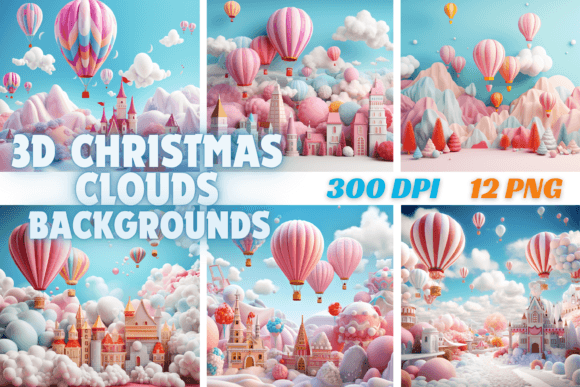
At their core, 3D Christmas Clouds Backgrounds are high-resolution digital images that utilize depth mapping, lighting effects, and texture rendering to simulate volumetric clouds infused with holiday motifs. Unlike standard 2D clip art, which often appears flat regardless of resolution, these backgrounds incorporate shading and perspective to create a sense of atmosphere. The "Christmas" element is typically integrated through subtle cues rather than overt clutter; think soft glows resembling starlight, faint hints of red and green within the cloud formations, or floating particles that mimic magical snow without obscuring the foreground content.
The distinct value proposition of this style lies in its versatility. A collection featuring 12 enchanting HD images, for instance, provides a curated range of moods—from bright and airy morning skies to deep, twilight hues suitable for evening promotions. The three-dimensional aspect ensures that when text or product photography is overlaid, the background recedes naturally, maintaining legibility while adding a layer of sophistication. This is particularly relevant for professionals aiming to avoid the "busy" look that often plagues holiday designs, where excessive ornaments and patterns compete for attention.
Comparative Analysis: 3D Clouds vs. Traditional Holiday Backdrops
When evaluating 3D Christmas Clouds Backgrounds against other available categories, several key differences emerge regarding application and audience reception.
- Vs. Flat Vector Illustrations: Traditional vector backgrounds are excellent for scalability and clean lines, making them ideal for print media like brochures or large banners. However, they can sometimes lack emotional warmth on digital screens. 3D cloud backgrounds offer a photorealistic or semi-realistic texture that feels more organic and immersive on websites and video headers, though they may not scale as infinitely as vectors without pixelation if the source resolution is fixed.
- Vs. Photorealistic Landscapes: Real photographs of winter skies provide authenticity but often come with uncontrollable variables—unwanted power lines, inconsistent lighting, or a lack of specific festive coloring. 3D rendered clouds allow for controlled artistic direction, ensuring the color palette aligns perfectly with brand guidelines while retaining a natural feel.
- Vs. Animated Video Loops: While motion backgrounds are engaging, they require more bandwidth and can distract from critical information in static ads or presentation slides. 3D still backgrounds strike a middle ground, offering the depth and visual interest of animation in a lightweight file format that loads instantly.
The choice ultimately depends on the medium. For a PowerPoint presentation or a website hero image, the static nature of HD 3D backgrounds is often superior, ensuring that the viewer's focus remains on the message rather than movement.
Strategic Use Cases and Best-Fit Scenarios
Not every project benefits from a whimsical cloud aesthetic. The effectiveness of 3D Christmas Clouds Backgrounds is highly context-dependent. They are particularly well-suited for industries that wish to convey innovation, lightness, or aspiration alongside their holiday messaging. Tech companies, financial services firms, and lifestyle brands often find that heavy-handed holiday tropes (like Santa Claus or reindeer) clash with their corporate identity. The cloud motif offers a subtle nod to the season—suggesting winter and celebration—without compromising professional integrity.
Furthermore, these backgrounds excel in scenarios requiring significant negative space. Because clouds naturally cluster and disperse, they create organic frames for text placement. This makes them an excellent choice for:
- Digital Greeting Cards: Where the message is paramount, and the background should support rather than dominate.
- Social Media Story Templates: The vertical composition of many cloud renders fits mobile formats perfectly, allowing for overlay stickers and interactive elements.
- Product Mockups: For items like cosmetics or tech gadgets, a soft, dreamy cloud background can enhance the perceived premium quality of the product during holiday promotions.
However, if the goal is to evoke nostalgia through traditional, cozy cabin vibes or rustic textures, these airy, modern backgrounds might feel too detached. In such cases, resources featuring wood textures, knitted patterns, or warm indoor lighting would be more appropriate alternatives.
Technical Considerations and Limitations
Before integrating these assets into a workflow, it is crucial to assess technical specifications. The term "HD" generally implies a resolution of at least 1920x1080 pixels, which is sufficient for most web and screen-based applications. However, for large-format printing, one must verify if the source files are available in higher densities (such as 4K or vector-based equivalents) to prevent graininess. A collection of 12 images provides variety, but consistency in lighting direction and color grading across the set is vital for maintaining a cohesive campaign look.
Another factor is file format compatibility. Most 3D backgrounds are delivered as JPG or PNG files. PNGs with transparency are particularly valuable if the designer intends to composite the clouds over other elements. If the backgrounds are opaque JPGs, blending them into existing layouts may require additional masking work in photo editing software. Users should also consider color profiles; ensuring the images are in sRGB is standard for web use, whereas CMYK conversion may be necessary for professional print runs, which can sometimes alter the vibrancy of the 3D lighting effects.
Making the Final Decision
Choosing 3D Christmas Clouds Backgrounds is less about following a trend and more about solving a specific design challenge: how to be festive without being cliché. If your project demands a modern, clean, and slightly magical atmosphere that allows foreground content to breathe, this category of assets is a strong contender. The trade-off is a potential lack of traditional "coziness," which may not resonate with audiences expecting classic holiday imagery.
Ultimately, the decision rests on the alignment between the visual tone of the background and the brand voice of the project. For those seeking to refresh their holiday toolkit with something that feels contemporary and versatile, exploring a diverse set of high-resolution 3D cloud designs offers a practical solution. By weighing the need for atmospheric depth against the requirements for legibility and brand consistency, creators can determine if this ethereal style is the right foundation for their next winter campaign.